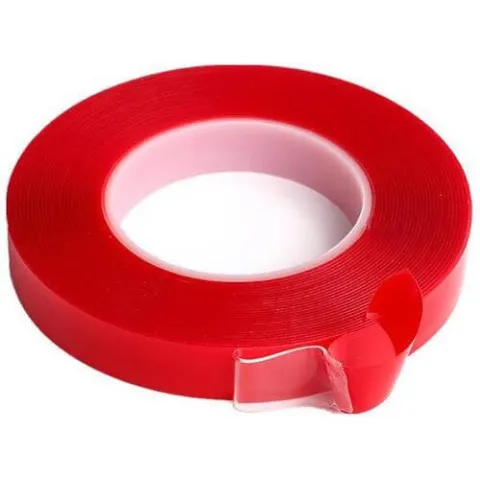
Die cutting in plain terms
Die cutting is a converting process that uses a shaped blade — the die — to cut sheets or rolls of material into identical, accurately sized parts. It works on comparatively soft or thin materials: paper, board, film, foam, rubber, felt, cloth, metal foil and, very commonly, pressure-sensitive adhesive tapes.
For adhesive tapes, die cutting is what turns a plain roll into a gasket, a mounting pad, an insulating washer or a label that drops straight into an assembly line. Instead of an operator cutting tape by hand, every part comes off the press with the same size, shape and hole positions.
In some trades the process has other names: in leather and shoe work it is often called clicking, and lighter steel-rule cutting is sometimes called dinking.
Main die cutting methods
Flatbed die cutting. A flat steel-rule die presses straight down onto the material, much like a cookie cutter. Tooling is relatively low in cost and quick to make, so flatbed is well suited to short and medium runs, thick foams and large parts. It is slower than rotary cutting.
Rotary die cutting. The die is a cylinder that rolls against an anvil as the material feeds through continuously. It is fast, holds tight tolerances and can be combined in line with laminating, printing or slitting stations. Tooling costs more, so rotary cutting pays off on high volumes.
Digital and laser cutting. Knife plotters and lasers cut shapes from a computer file without a physical die. They are ideal for prototypes and small batches, though cycle times are longer and some materials react to laser heat.
Kiss cutting versus through cutting
Two cut depths matter for tapes:
- Kiss cut: the blade cuts through the tape and adhesive but stops at the release liner. Parts stay on the liner, in a roll or sheet, and are peeled off one by one — the usual format for labels and pads.
- Through cut (or full cut): the blade cuts through every layer, producing loose individual pieces such as washers or gaskets.
Converters often combine layers before cutting — for example, laminating a foam to a Double Sided Tissue Tape or a Transfer Tape so the finished gasket arrives with its own adhesive.
Materials that are commonly die cut
| Material | Typical die-cut part |
|---|---|
| Double-sided tapes and transfer adhesives | Mounting pads, nameplate and lens adhesive, membrane switch layers |
| Foam tapes (PE, EVA, PU, acrylic foam) | Gaskets, dust and vibration seals, cushions, spacers |
| Films (polyester, polyimide, PVC) | Insulating washers, masks, protective windows |
| Metal foils (aluminium, copper) | EMI shielding, heat spreaders, grounding parts |
| Felt and nonwoven | Anti-rattle and anti-scratch pads |
| Thermal interface materials | Heat-transfer pads for electronics |
Foam Tape and Acrylic Foam Tape are among the most frequently converted materials because gaskets and mounting pads rarely match a standard roll width.
Where die-cut parts are used
- Electronics: fixing displays, lenses and batteries in phones, laptops and cameras; insulating and shielding parts.
- Automotive: emblem and trim mounting pads, anti-squeak pads, wire-harness and sound-damping parts.
- Appliances and HVAC: display and panel fixing, foam seals in air-conditioners and refrigerators.
- Signage and displays: pre-shaped mounting tapes for letters and panels.
- Medical and healthcare: device fixing parts and foam components.
- Packaging and printing: labels, envelopes and folded cartons — where the process started.
What to define before ordering die-cut parts
- A dimensioned drawing with tolerances, including hole positions and corner radii.
- The material stack: carrier, adhesive on each side, thickness and liner type.
- Kiss cut on a liner or loose through-cut parts.
- Delivery format: rolls, sheets or individual pieces, plus any easy-peel tabs.
- Expected annual volume, which decides between flatbed, rotary or digital cutting.
Key takeaways
- Die cutting produces repeatable shapes from tape, foam, film and foil.
- Flatbed suits short runs and thick materials; rotary suits high volumes; digital suits prototypes.
- Kiss-cut parts stay on a liner; through-cut parts are loose.
- Rounded corners on adhesive parts reduce the chance of peeling at the edges.
Frequently asked questions
What is the difference between kiss cutting and through cutting?
A kiss cut goes through the tape but not the release liner, so parts stay on a carrier for easy peeling. A through cut goes through all layers and gives loose parts.
Is rotary or flatbed die cutting better?
Neither is better overall. Flatbed tooling is cheaper and suits short runs or thick foams; rotary is faster and more economical for high-volume, tight-tolerance parts.
Which materials can be die cut?
Most soft or thin materials, including single- and double-sided tapes, foams, films such as polyester and polyimide, metal foils, felt, rubber and paper.
Why do die-cut adhesive parts often have rounded corners?
Sharp corners concentrate peel stress and are where lifting usually starts. A small corner radius helps the part stay down.
Tell us the surface, temperature and job — we'll recommend a grade and share its data sheet.