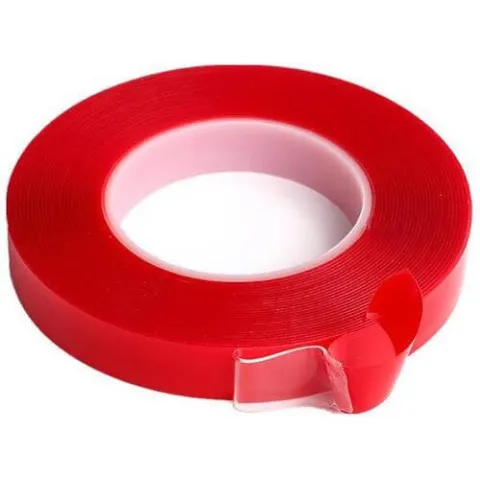
Foam tapes put a compressible layer between two surfaces. That layer lets the tape fill gaps, follow curves, absorb vibration and seal against dust, air or water in ways a thin film tape cannot. The foam type, its cell structure and its density decide how the tape behaves, so it pays to understand each before choosing.
How a foam tape works
When two parts are pressed together, a foam tape compresses and keeps pushing back. That recovery keeps the adhesive in contact with both surfaces even when they are slightly uneven or move with temperature. On a single-sided foam tape the same recovery force is what lets it act as a seal or gasket. On a double-sided foam tape it spreads the load across the whole bond area, which reduces stress concentrations compared with point fixings.
Main foam types
Acrylic foam (viscoelastic)
Here the core itself is a solid, closed-cell acrylic that behaves like a viscoelastic material: it flows slowly under load and absorbs energy, then recovers. Because the core and the adhesive are both acrylic, the tape behaves almost like a single structural layer. Acrylic Foam Tape is used for permanent mounting of panels, trims, signage and stiffeners, often replacing screws or rivets. It generally offers good UV, weather and ageing resistance and copes with differential expansion between metals, glass and plastics.
Polyethylene (PE) foam
Closed-cell PE foam is light, low cost and resistant to moisture. It is widely used for mounting mirrors, signs and accessories, and for general sealing. PE foams are firm and keep their shape, but compared with acrylic foam they have less ability to relax stress over time.
EVA foam
EVA (ethylene vinyl acetate) foam is softer and more rubber-like than PE at a similar density, with good cushioning and conformability. It is a common choice for anti-rattle pads, cushioning and sealing on appliances and electronics.
EPDM foam
EPDM is a synthetic rubber known for its weathering, ozone and UV resistance. EPDM foam tapes are used for outdoor sealing and gasketing in doors, windows, enclosures, HVAC equipment and vehicles, where the seal has to survive sun and rain for years.
PU (polyurethane) foam
PU foams are usually soft with good recovery, and can be made with open or closed cells. Open-cell PU is used for cushioning, sound and filter-type applications; denser closed-cell grades are used for sealing and gasketing.
The general Foam Tape range covers several of these foams for mounting, cushioning and sealing.
Open cell versus closed cell
- Closed-cell foam: each cell is sealed, so water and air cannot pass through the foam. This is the structure you need for weather seals, dust seals and glazing.
- Open-cell foam: cells are connected, so the foam breathes and compresses very easily. It is good for cushioning and sound damping but will not seal against water unless it is heavily compressed or specially treated.
Density and thickness
Density tells you how much material is in the foam. Higher density foams are firmer, stronger and more durable under repeated load; lower density foams are softer and compress easily, filling gaps with less force. Thickness should be chosen against the gap you need to fill: a tape normally works best when it is compressed by a moderate amount, not crushed flat and not barely touching. A seal that is too thin will leak at the low points; one that is too thick can push parts apart or stop a door closing.
Matching foam to the job
| Job | Typical foam | Key need |
|---|---|---|
| Permanent panel or trim mounting | Acrylic foam | Strength, stress relaxation, weather resistance |
| Mirrors, signs, accessories | PE foam | Firm, moisture-resistant, economical |
| Cushioning and anti-rattle | EVA or soft PU | Softness and recovery |
| Outdoor door and enclosure seals | EPDM foam | UV and weather resistance, closed cell |
| Glazing and frame sealing | Closed-cell foam or Glazing Tape | Sealing and cushioning of glass |
Application tips
- Clean surfaces with a suitable solvent such as isopropyl alcohol and water mix, and let them dry.
- Apply firm, even pressure along the full length; foam tapes need pressure to bring the adhesive into contact.
- Avoid stretching foam during application, as it will try to recover and may lift at the ends.
- Allow time for the adhesive to build strength before loading the joint, especially with acrylic systems.
- Apply within the temperature range recommended on the data sheet; cold surfaces greatly reduce initial adhesion.
Key takeaways
- Choose the foam for the job: acrylic for structural mounting, PE for economical mounting, EVA and PU for cushioning, EPDM for outdoor seals.
- Use closed-cell foam wherever water or air must be kept out.
- Match density and thickness to the gap and the compression force available.
- Surface preparation and pressure matter as much as the tape itself.
Frequently asked questions
What is the difference between open-cell and closed-cell foam tape?
Closed-cell foam has sealed cells, so it blocks water and air and is used for sealing. Open-cell foam has connected cells, so it breathes and compresses easily, making it better for cushioning than for sealing.
Why is acrylic foam tape used for structural mounting?
Its viscoelastic acrylic core spreads load, absorbs vibration and relaxes stress from thermal expansion, while offering good weather and ageing resistance. That makes it suitable for replacing some mechanical fasteners on panels and trims.
Which foam tape is best for outdoor sealing?
EPDM foam is a common choice because of its resistance to UV, ozone and weathering. A closed-cell structure is needed so water cannot pass through the foam.
How thick should a foam sealing tape be?
Choose a thickness that is moderately compressed when the parts are closed. Too thin will leave gaps, while too thick may stop parts from closing properly.
Tell us the surface, temperature and job — we'll recommend a grade and share its data sheet.