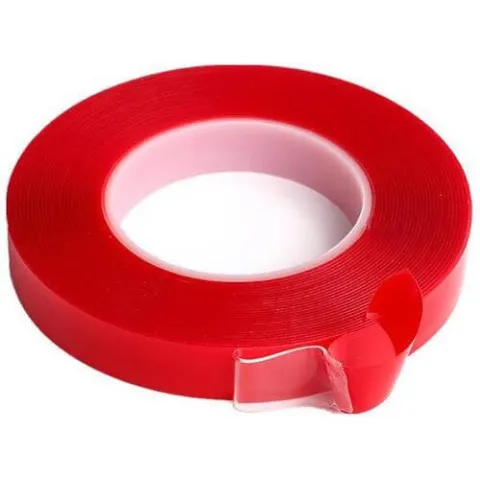
Why foam tapes come in several types
A double-sided foam tape has a foam core coated with adhesive on both faces. The foam fills gaps, absorbs movement and spreads load; the adhesive provides the grip. Changing the foam polymer changes stiffness, resilience, temperature behaviour and cost, so four foam types cover most industrial needs: PE, acrylic, EVA and PU.
All of them are supplied with a release liner on one side — paper or film — and in rolls, slit strips or die-cut shapes. SyncSol's Foam Tape and Acrylic Foam Tape pages list the available grades.
The four foam types
1. PE foam double-sided tape
Construction: closed-cell polyethylene foam, usually cross-linked for better strength and heat stability, coated on both sides with acrylic or rubber adhesive.
Character: light, firm, water-resistant and economical. Commonly white, black or grey, and offered in standard, high-density and very thin versions.
Uses: car interior and exterior trims, nameplates and badges, photo frames, mirrors, furniture trim, door and window seal strips, electrical nameplates and general mounting. Thin, high-density PE foam tapes are also used to fix and cushion parts in electronics.
2. Acrylic foam double-sided tape
Construction: a dense, viscoelastic acrylic foam core, frequently made from the same acrylic chemistry as its adhesive faces, so the whole tape behaves as one continuous adhesive layer.
Character: the highest strength and durability of the four. It resists UV, moisture, ageing and many chemicals, holds well under long-term load and absorbs differential expansion between materials. Commonly grey, black, white or clear, in thicknesses from well under 1 mm to a few millimetres.
Uses: replacing screws and rivets on vehicle trims and emblems, signage, façade and ACP panel stiffeners, glass and metal bonding, and appliance assembly.
3. EVA foam double-sided tape
Construction: soft closed-cell ethylene-vinyl acetate foam coated with rubber, hot-melt or acrylic adhesive.
Character: soft and conformable with good cushioning and shock absorption; economical. Hot-melt versions grab quickly but are best kept to indoor, moderate temperatures.
Uses: cushioning pads, seals and gaskets in appliances and electronics, household hooks, toys, sports goods, stationery and packaging inserts.
4. PU foam double-sided tape
Construction: polyurethane foam coated with acrylic or rubber adhesive.
Character: resilient — it recovers its thickness well after compression — with good toughness and good gap filling. Usually black or white.
Uses: mounting boards, signs and display panels, plastic strips, sheet-metal stiffeners and hooks; also gaskets that are compressed and released repeatedly.
Quick comparison
| Type | Strength | Cushioning | Outdoor durability | Relative cost |
|---|---|---|---|---|
| PE foam | Medium | Medium | Good with acrylic adhesive | Low |
| Acrylic foam | Very high | Medium | Excellent | Higher |
| EVA foam | Low to medium | High | Fair to good | Low |
| PU foam | Medium | High, with good recovery | Good | Medium |
Working temperature ranges differ by grade and are set largely by the adhesive, so confirm them on the specific data sheet rather than assuming one figure for a foam type.
How to choose
- Load and permanence: structural or long-term outdoor load points to acrylic foam; light mounting can use PE or EVA.
- Gap and flatness: uneven surfaces need a thicker, softer foam.
- Environment: heat, UV and moisture favour acrylic adhesive systems.
- Surfaces: low surface energy plastics may need a special adhesive or primer.
- Budget and volume: PE and EVA keep costs down on large-volume, lighter jobs.
For thin, non-foam double-sided bonding, compare Double Sided Tissue Tape.
Key takeaways
- PE foam: versatile, firm and economical.
- Acrylic foam: highest strength and weathering resistance for permanent bonding.
- EVA foam: soft and cushioning for sealing and light mounting.
- PU foam: resilient and good for repeatedly compressed parts.
Frequently asked questions
Which double-sided foam tape is the strongest?
Acrylic foam tape is generally the strongest and most durable, which is why it is used to replace mechanical fasteners.
Which foam tape is best for cushioning?
EVA and PU foam tapes are the softest and best at absorbing shock; PU recovers its thickness especially well after compression.
Is PE foam tape suitable for outdoor use?
Cross-linked PE foam with acrylic adhesive performs well outdoors for light to medium loads. For permanent structural bonds outdoors, acrylic foam tape is the safer choice.
What sets the temperature range of a foam tape?
Mostly the adhesive. Rubber and hot-melt adhesives soften sooner, while acrylic adhesives handle more heat and ageing.
Tell us the surface, temperature and job — we'll recommend a grade and share its data sheet.