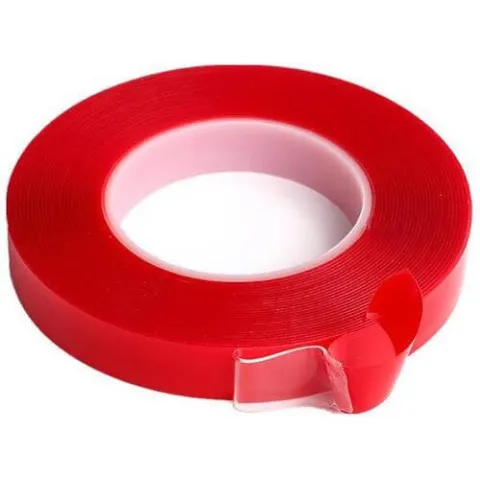
Two foam tapes, two different jobs
At a glance, acrylic foam tape and PE foam tape look alike: both are double-sided, both have a foam core and both arrive on a liner. Underneath, they are built differently and are meant for different levels of load and service life. Choosing the right one avoids both over-specifying (paying for strength you do not need) and under-specifying (bonds that creep or let go).
Construction
Acrylic foam tape has a dense, viscoelastic acrylic foam core. In many products the core and the adhesive surfaces are the same acrylic chemistry, so there is no weak boundary between foam and adhesive — the tape acts as one solid adhesive layer.
PE foam tape has a closed-cell polyethylene foam core, often cross-linked, with a separate adhesive coated on each side — usually acrylic, sometimes rubber. The foam and the adhesive are distinct layers.
Side-by-side comparison
| Feature | Acrylic foam tape | PE foam tape |
|---|---|---|
| Core | Viscoelastic acrylic foam | Closed-cell polyethylene foam |
| Adhesive | Acrylic, often continuous with the core | Acrylic or rubber coated on the foam |
| Bond strength | Very high, suitable for structural joints | Low to medium, for general mounting |
| Long-term load (creep) | Good resistance | Moderate |
| Stress handling | Absorbs expansion, vibration and impact | Cushions, but foam can split under high load |
| UV, weather and ageing | Excellent | Good with acrylic adhesive |
| Common colours | Grey, black, white, clear | White, black, grey |
| Typical liners | Coloured or clear film, or paper | Paper, glassine or coloured film |
| Thickness range | Thin to a few mm | Very thin to several mm |
| Relative cost | Higher | Lower |
Thickness and colour options vary from one product range to another; SyncSol's grade tables on each tape page give the exact sizes available.
Failure behaviour tells the story
When an over-loaded PE foam tape fails, the foam often splits down the middle, leaving foam on both parts. That shows the foam core, not the adhesive, is the limit.
When an acrylic foam tape is pulled apart in testing, it stretches considerably before failing, absorbing a lot of energy. That ability to stretch and recover is what lets it hold glass to metal or plastic to painted steel through years of temperature swings.
Where each one fits
Choose Acrylic Foam Tape for:
- Replacing screws, rivets or welds.
- Vehicle exterior trims, emblems and mouldings.
- Façade, cladding and curtain-wall components, and sign assembly.
- Bonding dissimilar materials that expand at different rates.
- Long service life outdoors.
Choose PE Foam Tape for:
- Nameplates, light trims, frames and mirrors.
- Interior automotive parts and accessories.
- Gaskets, dust seals and cushions in electronics and appliances.
- Door and window seal strips, and general indoor mounting.
- High-volume, cost-sensitive work where loads are modest.
Selection tips
- Estimate the load and how long it acts. Constant load, especially in peel or overhead, calls for acrylic foam.
- Look at the environment. Sun, rain and big temperature swings favour acrylic foam.
- Check the surfaces. Both need clean surfaces; low surface energy plastics may need a primer or special adhesive either way.
- Allow dwell time. Acrylic adhesives build strength over hours to days after application.
- Test. Run a trial on actual parts before committing to production.
For thin bond lines without foam, consider Double Sided Polyester Tape.
Key takeaways
- Acrylic foam tape: one-piece viscoelastic construction, very high strength, excellent weathering.
- PE foam tape: foam core plus separate adhesive, economical and fine for lighter mounting.
- Structural, permanent or outdoor work points to acrylic foam; lighter indoor jobs suit PE foam.
Frequently asked questions
Can PE foam tape replace acrylic foam tape?
Only for light, non-structural jobs. Under constant or high loads, outdoors, or between materials that expand differently, acrylic foam tape is the reliable choice.
Why is acrylic foam tape more expensive?
Its acrylic foam core is more complex to produce and gives much higher strength, creep resistance and weathering performance than polyethylene foam.
How can I tell which foam tape failed?
A PE foam tape that is overloaded usually splits through the foam. An acrylic foam tape tends to stretch a great deal before it lets go.
Do both tapes need surface preparation?
Yes. Clean, dry, dust-free surfaces are essential for any foam tape, and low surface energy plastics may need a primer.
Tell us the surface, temperature and job — we'll recommend a grade and share its data sheet.