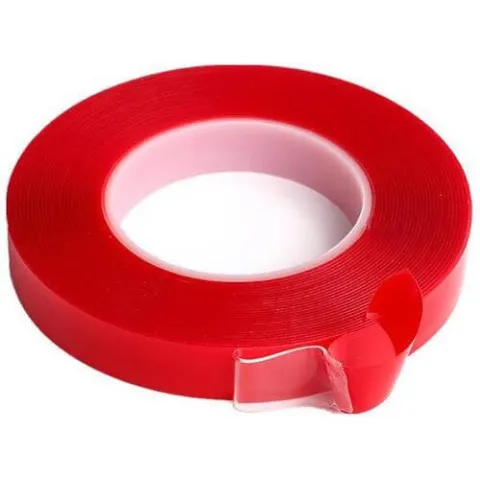
Engineers increasingly replace screws, rivets, welds and wet adhesives with double-sided tapes. Tape is not right for every joint, but where it fits it can simplify assembly, improve appearance and save weight. This guide compares the three main joining options so you can choose with clear eyes.
How each method carries load
Mechanical fasteners — screws, rivets, bolts, clips — concentrate load at small points. The material around each hole carries high local stress, which can lead to cracking, fatigue or tear-out, especially in thin sheets and plastics. Drilling also removes material and can break protective coatings, opening the door to corrosion.
Liquid adhesives — epoxies, polyurethanes, cyanoacrylates, silicones — spread load across the whole bond area and can reach very high strength. They need mixing or dispensing, controlled bond lines, fixturing while they cure, and attention to cure time, open time and fumes.
Adhesive tapes also spread load over the full bonded area, but the adhesive is already a controlled, uniform layer. Pressure-sensitive tapes give handling strength immediately and build to full strength over a period of hours to days. Foam tapes add a viscoelastic layer that can absorb vibration and accommodate different thermal expansion between materials.
Comparison table
| Factor | Tape | Mechanical fasteners | Liquid adhesives |
|---|---|---|---|
| Stress distribution | Even, over full area | Concentrated at holes | Even, over full area |
| Sealing | Can seal against dust and water | Needs gaskets or sealant | Can seal well |
| Appearance | Hidden, clean surfaces | Visible heads, holes | Hidden, but squeeze-out possible |
| Speed | Fast, no cure wait for handling | Fast, but needs drilling | Slower, needs cure and fixturing |
| Dissimilar materials | Good, especially with foam | Galvanic and expansion issues | Good, chemistry dependent |
| Vibration damping | Good with foam tapes | Can loosen over time | Rigid types transmit vibration |
| Disassembly | Possible with care | Easy | Usually difficult |
| Consistency | Uniform thickness every time | Depends on torque | Depends on mixing and dispense |
| Gap filling | Limited to tape thickness | Not applicable | Good with gap-filling grades |
| Very high loads and heat | Limited | Strong | Strong (structural grades) |
Where tape works well
- Bonding thin panels, trims, nameplates, signs and stiffeners where holes would spoil the surface.
- Joining dissimilar materials such as glass to metal or plastic to aluminium.
- Assemblies needing a seal against dust or water at the same time as a bond.
- High-volume lines where cure time or fixturing slows output.
- Lightweighting, where thinner materials can be used without hole reinforcement.
When not to use tape
Tape is the wrong choice, or needs careful engineering, when:
- The joint carries a heavy or safety-critical load, especially overhead, without a mechanical back-up.
- Sustained temperatures exceed the adhesive's continuous rating.
- One substrate is weak, crumbling or poorly bonded paint — the tape can only be as strong as the surface.
- Surfaces are heavily contaminated and cannot be cleaned.
- The joint has large or variable gaps beyond what the tape can fill.
- Frequent disassembly with a reusable fastener is required.
- Regulations or codes require a specific fastening method.
In many designs, the best answer is a hybrid: tape for sealing, appearance and stress spreading, combined with a few mechanical fixings for security or fire safety.
Key takeaways
- Tape spreads stress, seals and looks clean; fasteners give certainty and easy disassembly; liquid adhesives offer strength and gap filling at the cost of process time.
- Validate any tape joint with real parts, loads and temperatures.
For panel and trim bonding, consider acrylic foam tape. For thin, flat laminations, see transfer tape or double sided polyester tape. For glazing assemblies, glazing tape combines bonding with sealing.
Frequently asked questions
Can double-sided tape replace screws?
In many light and medium-duty joints it can, provided the substrates, load and temperature suit the tape and the design has been tested.
Is tape stronger than liquid adhesive?
Structural liquid adhesives generally reach higher ultimate strength; tape offers faster handling, cleaner processing and uniform thickness.
Why use foam tape on dissimilar materials?
The foam core flexes to absorb movement from different thermal expansion rates and vibration, reducing stress on the bond.
When should I combine tape and fasteners?
For heavy, overhead or safety-critical items, or where codes require mechanical fixing, use tape for sealing and stress spreading alongside fasteners.
Tell us the surface, temperature and job — we'll recommend a grade and share its data sheet.