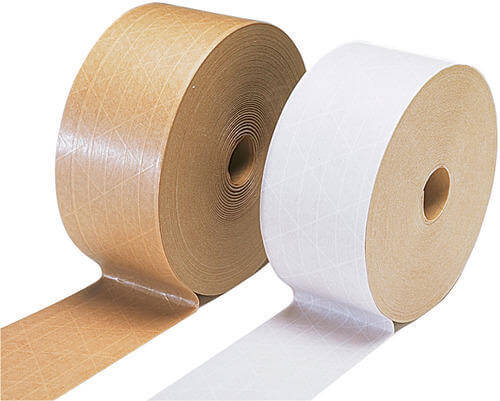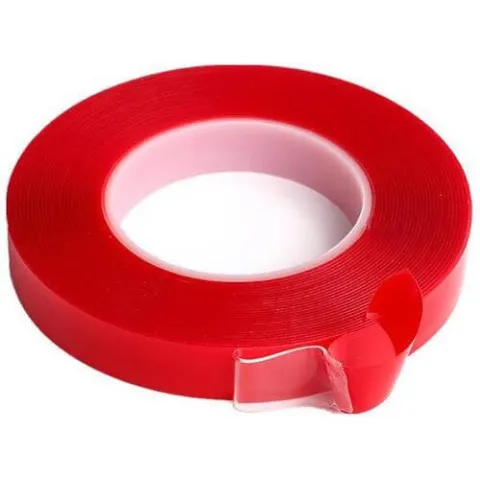
A double-sided tape carries adhesive on both faces so it can join two parts without screws, rivets or liquid glue. The tape you choose decides how strong, how thin and how easy to handle that joint will be. Most double-sided products fall into four families, defined by what sits in the middle: tissue, polyester (PET) film, nothing at all (transfer tape) or cloth.
The four main constructions
Tissue carrier
A thin non-woven tissue is coated with adhesive on both sides. The tissue gives just enough body for the tape to be unwound, slit and hand-torn, yet it stays flexible and conforms to slightly uneven surfaces. Double Sided Tissue Tape is a general-purpose choice for mounting paper, card, light plastics and foam, and for converting into die-cut parts where cost matters.
Polyester (PET) film carrier
A PET film core makes the tape dimensionally stable: it does not stretch when pulled, holds its shape when die-cut, and resists tearing. That stability helps when you laminate rigid parts, mount nameplates, bond membrane switches or need a clean edge on a precision die-cut. Because the film is strong and smooth, Double Sided Polyester Tape is also easier to apply with laminating machines without necking.
Transfer tape (adhesive only)
A transfer tape is a layer of adhesive on a release liner, with no carrier at all. Once applied and the liner removed, only the adhesive film is left between the parts. This gives the thinnest bond line and the best conformability, which is why Transfer Tape is common for graphic overlays, labels, thin plastic films and fine die-cuts. The trade-off is handling: without a carrier it can stretch, and it usually needs to be applied with a dispenser or laminator.
Cloth carrier
A woven cloth core gives strength and tear resistance with a thicker, more forgiving adhesive layer. Cloth-based double-sided tapes are used for carpet and floor coverings, exhibition work, and heavier or rougher materials where a film-based tape would be too thin to make full contact.
Thin tapes versus thick tapes
Thickness is not just about strength. A thin tape (a transfer film or a thin tissue construction) needs two smooth, flat surfaces in close contact; it gives a neat, almost invisible bond line and is ideal where tolerances are tight. A thicker tape carries more adhesive, flows into texture and small gaps, and can absorb a little movement between parts.
As a rule of thumb, the rougher, curved or more mismatched the two surfaces, the more adhesive mass you need. When the gap or irregularity is larger than the adhesive can fill, move to a foam tape rather than simply stacking layers.
What the release liner does
The liner protects the adhesive until use and controls how the tape is processed. Paper liners are common on hand-applied rolls; film liners such as PET or polypropylene are smoother, more dimensionally stable and preferred for precision die-cutting. Many tapes use a differential release, so one side comes off the roll first while the other stays protected for positioning. Liner colour and printing also help operators identify the product and the side to apply first.
Choosing for common jobs
| Application | Usual starting point | Why |
|---|---|---|
| Nameplates and badges | PET film or transfer tape | Stable, thin bond line, clean edges |
| Foam laminating | Tissue or transfer tape | Conforms to cell structure without adding stiffness |
| Graphics and overlays | Transfer tape | Thinnest layer, no visible carrier |
| Paper and film splicing | Tissue or specialised splicing tapes | Thin, quick tack, can be hand-torn |
| Precision die-cuts | PET film with film liner | Holds shape, does not stretch |
| Carpet and heavy fabric | Cloth carrier | Strength and adhesive mass for rough surfaces |
For paper mills and printing lines where the spliced material goes back into the pulper, a Double Sided Repulpable Tape should be used so the tape breaks down with the paper.
Adhesive chemistry matters too
The same carrier can be coated with different adhesives. Rubber-based adhesives give high initial tack and grab quickly on many surfaces, but are generally less resistant to heat, ageing and UV. Acrylic adhesives build strength over time, resist ageing and solvents better, and suit long-term or outdoor bonding. Low surface energy plastics such as PE and PP often need a modified adhesive or a primer.
Key takeaways
- Pick the carrier for handling and stability: tissue for general use, PET for stable die-cuts, none (transfer) for the thinnest bond, cloth for strength on rough surfaces.
- Match adhesive thickness to surface roughness; switch to foam for real gaps.
- Use film liners for precise converting work.
- Clean, dry surfaces and firm pressure are essential whichever tape you use.
- Test on your actual parts, including heat and ageing, before approving a tape.
Frequently asked questions
What is the difference between transfer tape and double-sided tape?
A transfer tape is adhesive only on a liner, with no carrier in the middle, so it gives a thinner and more conformable bond. A double-sided tape has a carrier such as tissue, film or cloth, which makes it easier to handle and die-cut.
When should I use a polyester carrier instead of tissue?
Choose polyester when you need dimensional stability, tear resistance or clean, precise die-cut parts, for example nameplates or membrane switch layers. Tissue is more economical and conformable for general mounting.
Can double-sided tape fill gaps between uneven parts?
Only small irregularities. Thicker adhesive helps on textured surfaces, but for real gaps or mismatched parts a foam tape is the better choice.
Why do some rolls have a printed or coloured liner?
The liner protects the adhesive and helps operators identify the product and the side to expose first. Film liners are also used where precise die-cutting is needed.
Tell us the surface, temperature and job — we'll recommend a grade and share its data sheet.