Four ways a tape can bond
Before choosing a backing or size, it helps to know how a tape actually creates its bond. Industrial tapes fall into four groups by activation method: pressure-sensitive, heat-activated, water-activated and non-adhesive (self-adhering). Each suits different jobs.
1. Pressure-sensitive tapes
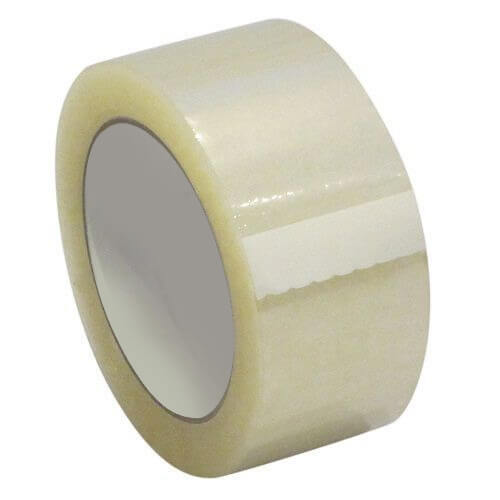
Pressure-sensitive adhesive (PSA) tapes are by far the most common. The adhesive is permanently tacky at room temperature and bonds with pressure alone — no water, solvent or heat is needed. Rubber, acrylic and silicone adhesives all fall into this group.
How they bond: pressure pushes the soft adhesive into the microscopic roughness of the surface ("wetting out"). The more contact, the stronger the bond, which is why firm pressure and some dwell time matter.
Application guidance often given in the industry:
- Apply firm, even pressure with a roller rather than a light touch; values in the order of 10–20 N/cm² are commonly recommended.
- Apply at moderate temperatures, roughly 15–35 ℃. When cold, the adhesive is too firm to wet the surface; when hot, film backings can stretch during application and pull back later.
- Make sure surfaces are clean, dry and free from oil, dust and release agents.
Examples: BOPP Tape for cartons, Masking Tape, double-sided and foam tapes, PVC insulation tape, aluminium foil tape and protective films.
2. Heat-activated tapes
Heat-activated tapes are non-tacky, or only slightly tacky, at room temperature. They bond when heated — typically well above room temperature, often around 80 ℃ or higher depending on the product — and pressed, then gain strength as they cool.
Why use them: they can be positioned without sticking, have no tack to collect dust, and can form very strong bonds to difficult surfaces such as some rubbers, EPDM and plastics. Some film and foam versions are used in automotive and electronics assembly; heat-seal tear strips are used in packaging.
Watch-outs: they need heating equipment and controlled temperature, time and pressure.
3. Water-activated tapes
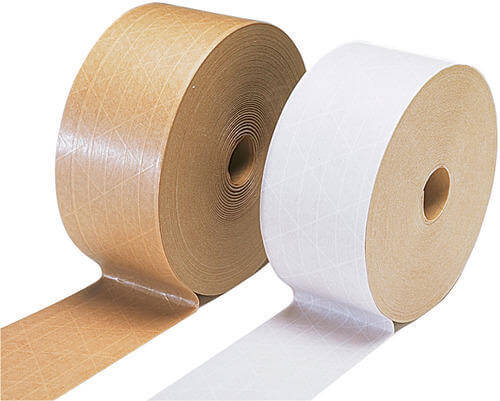
Water-activated, or gummed, tape is a paper — usually kraft — coated with a dry, starch-based adhesive that turns sticky when moistened. It is applied from a dispenser that wets the gum and cuts the length.
Why use it: the wet adhesive soaks into the fibres of corrugated board, creating a bond that is very hard to open without visible damage. It is paper-based and works well with paper recycling. Reinforced versions include fibreglass yarns between two paper layers for heavy cartons.
Examples and alternatives: Kraft Paper Tape and Security Packing Tape.
4. Non-adhesive and self-adhering tapes
Some tapes stick to themselves rather than to the surface:
- Self-fusing (self-amalgamating) rubber or silicone tapes are stretched and wrapped; the layers fuse into a solid sleeve for electrical insulation and sealing.
- PTFE thread-seal tape has no adhesive at all; it is wrapped on pipe threads to seal and lubricate.
- Cling films hold by surface attraction.
Comparison at a glance
| Type | Activated by | Main strengths | Typical uses |
|---|---|---|---|
| Pressure-sensitive | Pressure | Instant, easy, widest choice | Packing, masking, mounting, insulation |
| Heat-activated | Heat and pressure | Repositionable before bonding, strong final bond | Automotive, electronics, tear strips |
| Water-activated | Moisture | Tamper-evident, paper-recyclable | Carton sealing |
| Self-adhering | Stretch or wrap | Bonds to itself, no residue | Cable splices, pipe threads |
Key takeaways
- Most industrial tapes are pressure-sensitive; pressure, temperature and clean surfaces decide the bond.
- Heat-activated tapes trade convenience for very strong bonds to difficult materials.
- Water-activated tape gives tamper-evident carton seals.
- Self-fusing and PTFE tapes seal without a conventional adhesive.
Frequently asked questions
What is a pressure-sensitive tape?
It is a tape with a permanently tacky adhesive that bonds with pressure alone, without water, solvent or heat. Most industrial tapes are pressure-sensitive.
Why does tape stick poorly in cold conditions?
At low temperatures the adhesive stiffens and cannot flow into the surface roughness, so contact area and bond strength drop. Apply at moderate temperatures where possible.
When is water-activated tape preferred?
For carton sealing where tamper evidence and paper recyclability matter, because the adhesive bonds into the board fibres.
Is PTFE thread-seal tape an adhesive tape?
No. It has no adhesive and works by being wrapped tightly on pipe threads, where it seals and lubricates the joint.
Tell us the surface, temperature and job — we'll recommend a grade and share its data sheet.