What a masking tape has to do
A masking tape has a short but demanding life. It must stick firmly enough that paint, primer or powder cannot creep under the edge, survive whatever the process throws at it (solvents, ovens, abrasive blasting), and then come off in one piece without leaving adhesive behind or lifting the fresh coating. Those three requirements pull in different directions, which is why there is no single "best" masking tape — only the right one for a given process window.
The two variables that decide most choices are temperature and time at temperature. A tape that is perfectly happy at 80 ℃ for 30 minutes can fail badly at 120 ℃ for the same period, and a tape that survives a short cure can still leave residue if the part sits in the oven twice as long as planned.
The three main families
General-purpose crepe paper masking
Most everyday masking tape is a creped (lightly crinkled) paper backing coated with a natural or synthetic rubber adhesive. The crepe lets the tape stretch slightly and follow gentle curves, and the paper tears cleanly by hand. It suits interior painting, spray booths running at or near room temperature, light air-dry or low-bake finishes, labelling and bundling. See crepe paper tape and general masking tape for typical grades.
The weakness of standard crepe is heat and UV: rubber adhesives soften, oxidise and transfer to the surface when baked too hot or left on in sunlight for days.
High-temperature paper masking
High-temperature crepe tapes use a more saturated paper and a heat-resistant rubber or acrylic adhesive. They are the usual choice for automotive and general industrial paint lines where panels pass through a bake oven after spraying. Always check the data sheet for both the rated temperature and the rated dwell time, because these grades are typically specified as a combination (for example, a maximum temperature for a stated number of minutes) rather than a single headline figure.
Polyester film with silicone adhesive (powder coating)
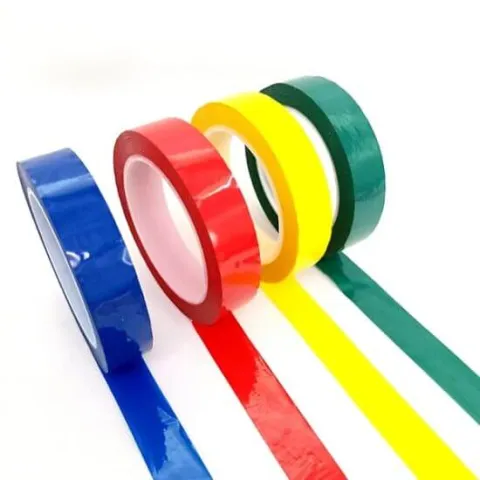
Powder coating is cured at noticeably higher temperatures than wet paint, usually in the range of roughly 160–200 ℃ for several minutes to around half an hour, depending on the powder chemistry. Paper tapes generally cannot cope. The standard answer is a thin polyester tape (PET film) with a silicone pressure-sensitive adhesive. Polyester stays dimensionally stable in the oven, gives a crisp paint line, and the silicone adhesive releases cleanly after curing. Leading polyester/silicone masking grades are rated up to about 200 ℃.
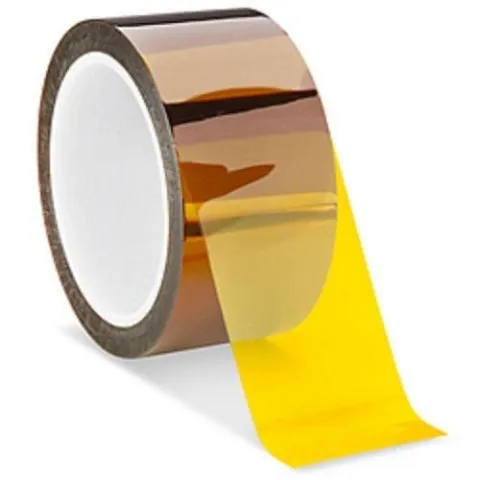
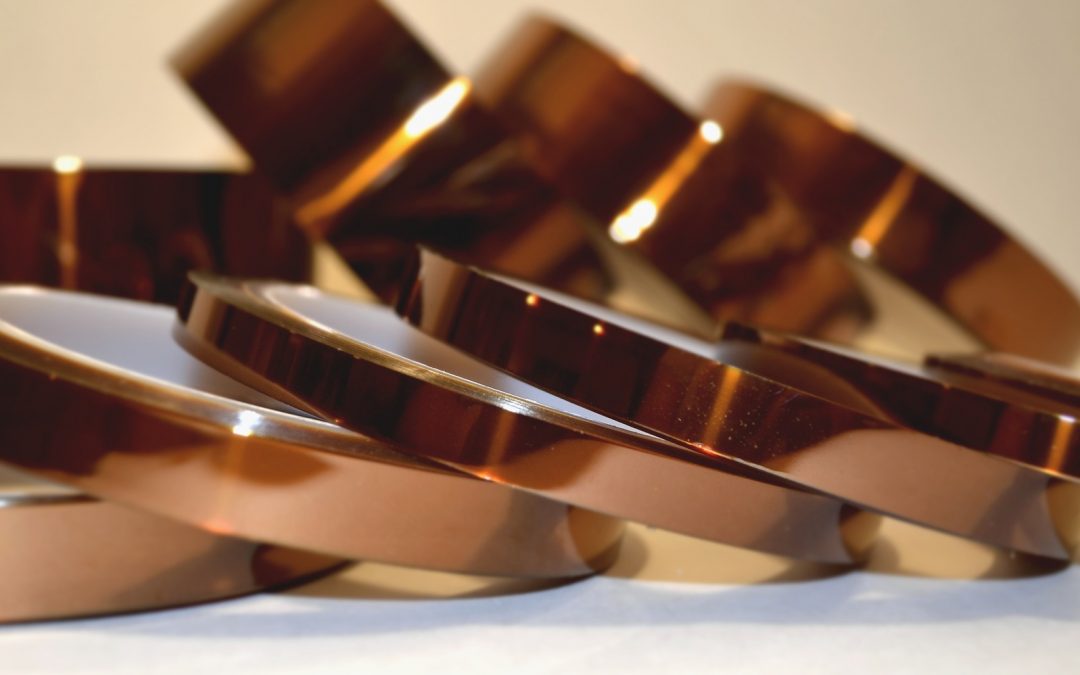
For still hotter or longer cycles — for example, solder masking on circuit boards or some plasma and thermal-spray processes — polyimide film tape with silicone adhesive is used; see polyamide tape on our site for this film-based option.
Choosing by bake temperature and time
| Process | Typical choice | Watch out for |
|---|---|---|
| Air-dry paint, room temperature | General-purpose crepe | Leaving tape on for many days, UV exposure |
| Low-bake paint (light oven cure) | High-temperature crepe | Exceeding rated dwell time |
| Powder coating cure | Polyester film + silicone adhesive | Silicone contamination near surfaces to be painted later |
| Very high heat, solder masking | Polyimide film + silicone adhesive | Cost; use only where heat demands it |
| Abrasive blasting before coating | Thick rubber or PVC masking | Thin films may be cut through |
A practical rule: pick a tape whose rated temperature is comfortably above your oven set point, and confirm the rated time covers the longest realistic dwell, including line stoppages and re-bakes.
Getting clean removal
- Clean and dry the surface first. Oil, release agents and dust stop the edge sealing properly and can make the adhesive behave unpredictably.
- Press the edge down firmly. Run a fingernail, squeegee or roller along the paint line; most bleed-under happens because the edge was never fully wetted out.
- Remove at the right moment. Wet paint lines are usually cleanest when the tape is pulled while the coating is still slightly soft. For powder coating, many shops remove the tape while the part is still warm, which tends to give a cleaner break at the coating edge.
- Pull back on itself. Peel at a low angle, folding the tape back over itself, steadily and not in jerks.
- Use pre-cut shapes for repeat jobs. Discs, plugs and caps save time on threaded holes and studs in powder-coating lines.
Common mistakes
- Using ordinary crepe in a bake oven because "it is only a few minutes" — residue and charring are the usual result.
- Rating the tape on temperature alone and ignoring time at temperature.
- Leaving masking tape on outdoors for days; UV can bake the adhesive onto the surface.
- Using a silicone-adhesive tape on surfaces that will later be painted or bonded, without cleaning — silicone traces can cause fish-eyes and adhesion problems.
- Stretching the tape around tight curves so it lifts back during the cure.
Key takeaways
- Match the tape family to the process: crepe for room temperature, high-temperature crepe for paint bakes, polyester/silicone for powder coating, polyimide for the hottest work.
- Check both maximum temperature and dwell time on the data sheet.
- Prepare the surface, seal the edge, and remove at the right moment for a sharp line.
- Trial new tapes on a scrap part before switching a production line.
Frequently asked questions
Can normal masking tape be used for powder coating?
Generally no. Powder cure temperatures are usually well above what standard crepe paper and rubber adhesive can tolerate, so a polyester film tape with silicone adhesive is the usual choice.
Why does masking tape leave residue?
The most common causes are heat or time beyond the tape's rating, prolonged UV exposure, or leaving the tape in place far longer than intended. A grade with a higher rating or earlier removal normally solves it.
When should I remove masking tape after painting?
For wet paint, a clean line is usually easiest while the coating is still slightly soft. For powder coating, removing the tape while the part is still warm often gives a cleaner edge.
Is polyimide tape needed for powder coating?
Usually not. Polyester/silicone tape covers most powder cure cycles; polyimide is reserved for higher temperatures or longer exposures, such as solder masking.
Tell us the surface, temperature and job — we'll recommend a grade and share its data sheet.