What filament tape is
Filament tape — often called strapping tape — is a film backing, usually polyester or polypropylene, reinforced with continuous yarns embedded in the adhesive layer. The yarns carry the load, the film holds them together and protects them, and a pressure-sensitive adhesive (commonly synthetic rubber, sometimes acrylic) bonds the tape to the surface. The result is a tape with tensile strength far beyond normal packaging tape, able to hold heavy cartons, bundle steel or timber, and secure parts in transit.
Glass versus polyester filaments
Glass fibre filaments
Glass yarns are very strong and stretch very little before breaking. That low elongation is the main reason they are chosen: a glass-reinforced tape holds a load tightly without creeping or relaxing, which suits unitising, bundling heavy items and securing moving parts. The trade-off is that glass is brittle when cut across or sharply folded, and the tape is less tolerant of impact than a more elastic tape.
Polyester filaments
Polyester yarns have somewhat lower tensile strength for the same yarn count but more elongation and better impact and abrasion resistance. They absorb shock rather than snapping, and are often favoured where loads are dynamic, where scuffing is expected, or where a less brittle edge is wanted.
Mono-directional and bi-directional
Mono-directional filament tape has all the yarns running lengthwise. It is extremely strong along its length — ideal for strapping around a carton or bundle — but can split along its length because there are no yarns across the width.
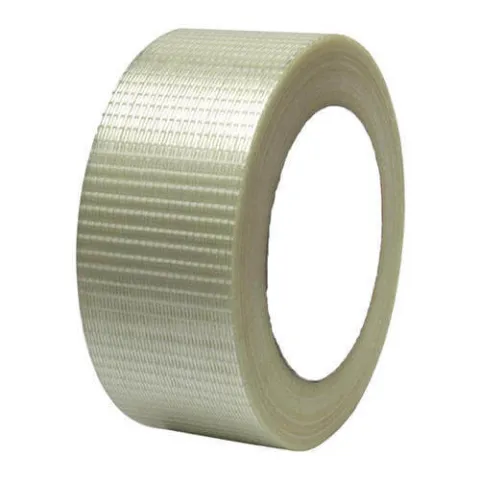
Bi-directional or cross filament tape adds yarns running across the width, or in a diagonal mesh, as well as lengthwise. That gives strength in two directions, resistance to splitting and puncture, and better hold when the tape is used as a patch or reinforcement rather than as a band. It is also generally easier to tear across when needed.
| Construction | Best for | Limitation |
|---|---|---|
| Mono-directional | Strapping, bundling, carton closure under load | Can split lengthwise |
| Bi-directional (cross) | Reinforcing, patching, coil holding, irregular loads | Usually higher cost per metre |
Understanding tensile strength figures
Tensile (breaking) strength is the force needed to break a strip of tape of standard width, measured on a tensile tester under conditions defined in methods such as ASTM D3759 (tensile strength and elongation of pressure-sensitive tapes). Data sheets quote it in different units, so always compare like with like:
- N/25 mm or N/10 mm — newtons per stated width; convert by scaling the width.
- N/cm — newtons per centimetre of width.
- kg/25 mm or kgf/inch — older force units still used in many markets (1 kgf ≈ 9.81 N).
- lb/in — pounds-force per inch of width, common on US data sheets.
Elongation at break, usually given as a percentage, tells you how much the tape stretches before failing — low for glass, higher for polyester. Adhesion (peel) values, often measured according to ASTM D3330 or equivalent, describe how well the tape sticks, not how strong it is; a strong tape with poor adhesion will simply peel off under load.
Typical uses
- Bundling and strapping: pipes, rods, timber, steel sections and profiles held together for handling.
- Heavy carton closure: cartons with dense contents, and export packing where cartons are handled many times.
- Coil and metal holding: securing the tail end of steel and aluminium coils and preventing coils from unwinding.
- Appliance transit: holding doors, drawers, shelves and trays of refrigerators, washing machines, ovens and similar goods in place during shipping. Here clean removal is important, so grades with low-residue adhesives are chosen.
- Reinforcement: strengthening hand-holes, carton corners and fibreboard joints.
Getting good results
- Apply to clean, dry surfaces and press firmly along the full length so the adhesive wets out.
- For strapping, wrap with enough overlap onto itself — tape-to-tape bonding is usually stronger than tape-to-carton.
- Avoid nicking the edges; a small cut can start a tear in mono-directional tape.
- On painted or delicate surfaces (appliance transit), test removal after storage at realistic temperatures.
- Store rolls in moderate conditions; cold rolls lose tack and very warm rolls may ooze.
Key takeaways
- Glass filaments for maximum strength with minimal stretch; polyester filaments for toughness and shock absorption.
- Mono-directional for straight-line strapping; bi-directional for reinforcing and split resistance.
- Compare tensile figures in the same unit and width, and check adhesion separately.
- For appliances and finished surfaces, choose a clean-removal grade and test it.
Frequently asked questions
What is the difference between filament tape and cross filament tape?
Filament tape has yarns running only lengthwise, giving very high strength along the roll. Cross filament tape adds yarns across the width, adding split and puncture resistance.
Are glass or polyester filaments stronger?
Glass filaments typically give higher tensile strength with very low stretch. Polyester filaments stretch more and handle impact and abrasion better.
How do I compare tensile strength values from different data sheets?
Convert them to the same unit and width, for example N/25 mm. Note that 1 kgf is about 9.81 N and widths may be quoted per 10 mm, 25 mm, cm or inch.
Can filament tape be used on appliances?
Yes, it is widely used to hold doors, shelves and drawers during transit. Choose a low-residue grade and test removal on the actual finish.
Tell us the surface, temperature and job — we'll recommend a grade and share its data sheet.